
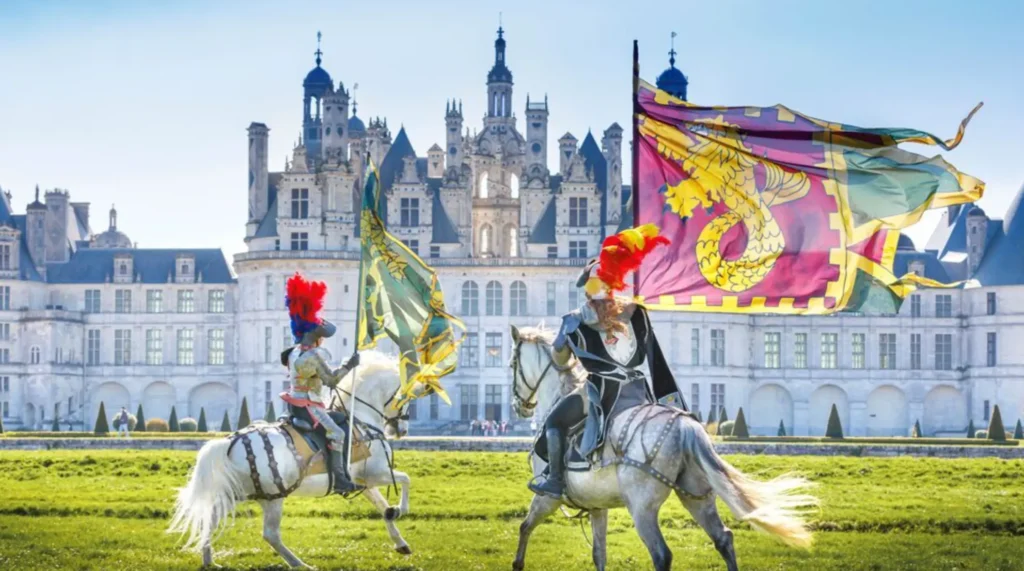
Château de Chambord: Why a French King Built a Palace He Barely Lived In
King François I commissioned one of the most ambitious buildings of the French Renaissance, yet spent only a few months there during his entire reign. The story of Château de Chambord reveals a world of royal rivalry, architectural experimentation and political ambition.
When King François I arrived at Château de Chambord, his furniture came with him.
In sixteenth-century France, the royal court travelled regularly between residences, bringing tapestries, furnishings, tableware and other necessities. Chambord was no exception. Once the king departed, much of its splendour disappeared with him, leaving behind vast rooms and corridors awaiting the next royal visit.
It was an unusual arrangement for such an ambitious building. Rising from the forests of the Loire Valley, Chambord was intended to be one of the architectural achievements of François I’s reign. Its great towers, elaborate roof terraces and ingeniously designed staircase reflected the king’s determination to bring the ideals of the Italian Renaissance to France.
Yet according to records maintained by the Domaine national de Chambord, only about 73 days of François I’s presence at the château can be documented. He may have visited more often, but even allowing for unrecorded stays, it was never his principal residence.
For a monarch who devoted considerable resources to its construction, this seems surprising. To understand why Chambord was built, however, it helps to consider what a royal palace represented in Renaissance Europe.
A King’s Ambition in the Loire Valley
François I became King of France in January 1515, shortly before his twenty-first birthday. Eight months later, he led his army to victory against Swiss forces at the Battle of Marignano in northern Italy.
The Italian campaigns exposed the young king to a flourishing artistic culture. Architecture, painting and engineering were undergoing significant changes, supported by wealthy patrons and rulers who regarded artistic achievement as an expression of political prestige.
François I returned to France with a growing interest in Renaissance ideas. He invited Italian artists to his court, commissioned ambitious building projects and cultivated a reputation as a patron of learning and the arts.
Leonardo da Vinci was among those who accepted his invitation. In 1516, the Italian master settled at Clos Lucé, near Amboise, where he spent the final years of his life under royal protection.
Three years later, François I launched the project that would become Château de Chambord.
The location was hardly an obvious choice for a great palace. Chambord lay in the Sologne, an area of woodland, marshes and hunting grounds near Blois. The site was crossed by the River Cosson, and preparing the ground for construction required considerable work.
But the forests were part of its attraction. Hunting occupied an important place in the life of the French court, serving both as aristocratic recreation and an opportunity for the king to entertain influential guests.
On 6 September 1519, François I formally initiated the building project. Construction continued, with interruptions, for much of the remainder of his reign.
The scale of the undertaking was considerable. Existing structures had to be cleared, the difficult terrain prepared and large quantities of building materials brought to the site. Military campaigns periodically disrupted the work, particularly after the disastrous French defeat at Pavia in 1525, when François I was captured by imperial forces.
Even so, the king continued to invest in Chambord.
By the time of his death in 1547, the château had acquired much of its distinctive appearance, although important sections remained unfinished.
The Mystery of Chambord’s Architect
One of the most intriguing questions about Chambord has never been conclusively answered: who designed it?
The architect’s identity remains uncertain, largely because the surviving records of the original building project are incomplete. Documents relating to the royal construction works were dispersed or destroyed in the eighteenth century, leaving historians without definitive evidence of the person responsible for the initial plans.
Leonardo da Vinci has long figured prominently in discussions of the château’s design.
His connection to François I is well documented, and several features of Chambord resemble ideas found in Leonardo’s architectural studies. The building’s centralized plan, sophisticated circulation arrangements and double-helix staircase have all prompted comparisons with his drawings.
Leonardo died at Clos Lucé on 2 May 1519, several months before construction was formally launched. He therefore could not have supervised the building work, although he may have contributed ideas during the earlier planning stages.
The Domaine national de Chambord acknowledges his influence while maintaining that the architect’s identity remains unknown.
Other architects and master builders would certainly have played important roles as construction progressed. The surviving building is the product of a long and evolving project rather than the work of a single identifiable designer.
Whatever its origins, Chambord introduced an architectural language that was strikingly different from that of earlier French royal residences.
Its massive corner towers recall the medieval fortress, while the carefully organized interior and decorative details reveal the influence of Italian Renaissance design.
The two traditions meet most dramatically in the château’s celebrated staircase.
A Staircase That Still Puzzles Visitors
At the centre of Chambord’s main building stands a staircase unlike those found in most European palaces.
It consists of two separate flights that spiral around a common central axis. People using opposite flights can ascend or descend at the same time, catching sight of one another through openings in the structure without crossing paths on the stairs.
The arrangement is both practical and theatrical.
Visitors moving through the château experience a carefully controlled series of views, openings and changes in perspective. The staircase also organizes the building’s interior, with four large halls extending from its central position.
This symmetrical arrangement was unusual in French royal architecture at the time.
Above the staircase, the building opens onto a series of terraces surrounded by towers, lanterns, sculpted chimneys and elaborate stone decoration.
Seen from the ground, Chambord’s roofline resembles a dense collection of towers and miniature buildings. From the terraces, the visitor can appreciate the detail of the stonework and the extent of the surrounding forest.
François I’s personal emblem, the salamander, appears repeatedly in the château’s decoration, together with royal initials and other symbols of the monarchy.
These details were carefully chosen. For a Renaissance ruler, architecture offered a way to express authority, taste and cultural sophistication. Visitors did not need to read a proclamation to understand whose palace they had entered.
The Emperor Who Came to Chambord
A particularly revealing episode occurred in December 1539, when François I welcomed Charles V, the Holy Roman Emperor, to Chambord.
The two rulers had spent years struggling for influence in Europe. Their rivalry had produced military campaigns, shifting alliances and the humiliation of François I’s capture at Pavia.
Charles V was travelling from Spain towards the Low Countries when the French king invited him to pass through France. The journey offered an opportunity for diplomacy, but also for an elaborate display of royal hospitality.
On 18 December 1539, the emperor arrived at Chambord, where he spent the night.
The main keep had been completed, although construction elsewhere continued. Preparations for the visit provided François I with an opportunity to present his château to one of Europe’s most powerful rulers.
The choice of setting was significant. Chambord’s architectural scale and novelty demonstrated the resources available to the French crown, as well as the king’s willingness to support ambitious artistic projects.
The château’s isolated location mattered little on such an occasion. Its value lay in the impression it could make on guests whose opinions carried political weight.
The visit remains one of the clearest illustrations of Chambord’s original purpose.
François I did not require a permanent household there for the building to serve him. An occasional royal visit, carefully arranged for the right audience, could justify a great deal of expense.
Life After François I
The king’s death in 1547 left Chambord unfinished. His successors continued parts of the work, but the château never became the permanent centre of the French monarchy.
During the seventeenth century, it gained renewed importance under Louis XIV.
The Sun King visited Chambord for extended autumn stays, using the estate for hunting and court entertainment. He also ordered alterations and construction work to make the building more suitable for the needs of his household.
One of the château’s most memorable cultural events took place during this period.
On 14 October 1670, Molière’s comedy Le Bourgeois gentilhomme, with music by Jean-Baptiste Lully, received its first performance at Chambord.
The play, commissioned for Louis XIV’s entertainment, satirized the social ambitions of a wealthy bourgeois gentleman eager to acquire the manners and status of the aristocracy.
Its premiere placed Chambord at the centre of an important episode in French theatrical history. The château originally built to express the ambitions of François I had become a setting for the artistic life of another powerful monarch.
Over subsequent centuries, Chambord experienced further changes in ownership, occupation and use. Its immense size made it difficult to maintain, and its original function as a royal hunting palace gradually lost its relevance.
Yet its architectural importance was increasingly recognized. The château received protection as a historic monument during the nineteenth century, helping secure its survival at a time when many historic buildings elsewhere in Europe faced neglect or demolition.
How Chambord Helped Save the Mona Lisa
One of the least expected chapters in Chambord’s history began in 1939.
As the threat of war spread across Europe, French museum authorities organized the evacuation of major artworks from Paris and other vulnerable locations.
The Louvre’s collections presented a particularly difficult challenge. Paintings, sculptures and other valuable objects had to be packed, transported and stored under conditions that would protect them from bombing, damage and possible seizure.
Chambord was selected as one of several important storage locations.
Its large rooms and relatively remote position made it suitable for receiving substantial quantities of artwork. The château was closed to ordinary visitors and became part of an extensive effort to safeguard France’s cultural collections.
Among the works that passed through Chambord was Leonardo da Vinci’s Mona Lisa.
Eugène Delacroix’s Liberty Leading the People and the medieval tapestry series The Lady and the Unicorn were also among the treasures sheltered there.
There is a historical coincidence in this episode. Chambord’s design bears the influence of Leonardo’s architectural thinking, and centuries later the building offered temporary protection to his best-known painting.
During the war, the château served a purpose its original builders could scarcely have imagined.
Today, this episode forms part of the historical interpretation presented at Chambord, documenting the work undertaken to protect French art during the conflict.
The Forest Behind the Château
The surrounding estate has always been essential to Chambord’s identity.
Today, the Domaine national de Chambord extends across approximately 5,440 hectares and is enclosed by a stone wall some 32 kilometres long. It is regarded as the largest enclosed park in Europe.
The origins of the estate lie in François I’s plans for an extensive royal hunting reserve. Its boundaries developed over time, with later owners enlarging the property and completing sections of the enclosing wall.
Much of the landscape remains wooded, with ponds, meadows and areas of wetland supporting a diverse range of wildlife.
Red deer and wild boar inhabit the estate, while its forests and waterways provide habitats for numerous species of birds, plants and other animals.
For modern visitors, the contrast between the cultivated architectural setting and the surrounding woodland is a defining feature of Chambord.
The château’s terraces offer views across a landscape that still recalls its origins as a royal hunting domain.
The estate is also an important site for nature conservation. More than 1,000 hectares are accessible for public walking, allowing visitors to experience an environment that has been closely associated with the building for over five centuries.
Chambord’s Place in French Heritage
The French state acquired Chambord and its estate in 1930, ensuring the monument’s long-term preservation as part of the country’s national heritage.
In 1981, the château and estate were inscribed on the UNESCO World Heritage List. In 2000, they were incorporated into the wider Loire Valley World Heritage designation, recognizing the region’s exceptional architectural and cultural landscape.
Restoration and conservation work have continued, including the recreation of the château’s formal French gardens in 2017.
These projects reflect a broader effort to preserve Chambord while making its history accessible to contemporary visitors.
The building is particularly valuable because it brings together several important periods of French history. Its architecture reflects the Renaissance ambitions of François I, its later development illustrates the cultural life of the Bourbon monarchy, and its twentieth-century history reveals the measures taken to protect France’s artistic heritage during wartime.
Few buildings preserve such a varied record within a single estate.
For visitors interested in French history, Chambord offers an opportunity to see how architecture, royal politics, landscape and cultural patronage were connected across successive generations.
A King’s Lasting Legacy
François I made his final recorded visit to Chambord in 1545, two years before his death. By then, the royal apartments were substantially developed, although the wider construction project remained incomplete.
The king had spent much of his reign involved in wars, diplomacy and the administration of his kingdom. Chambord was only one of several royal residences associated with him, and the demands of government left little opportunity for prolonged stays.
Yet the limited number of days he spent there says little about the importance he attached to the project.
Chambord was conceived in an age when rulers competed through architecture as well as warfare. A palace could communicate wealth and ambition long after the departure of its owner, and its reputation could travel far beyond the borders of the kingdom.
That is precisely what happened.
François I died without seeing the château finished. The royal court eventually moved on, the political circumstances that inspired its construction disappeared, and the monarchy itself came to an end.
Chambord remained.
More than five centuries after work began, the château is still closely associated with the king who commissioned it. Its architecture has become part of France’s national identity, and its distinctive silhouette is recognized around the world.
François I spent relatively little time within its walls. His decision to build it, however, has outlasted almost everything else from his reign.
Interested in French Citizenship?
Discover whether you may qualify for French citizenship through ancestry, marriage, or naturalization. Our team provides professional legal assistance with eligibility assessments, documentation, and applications.