
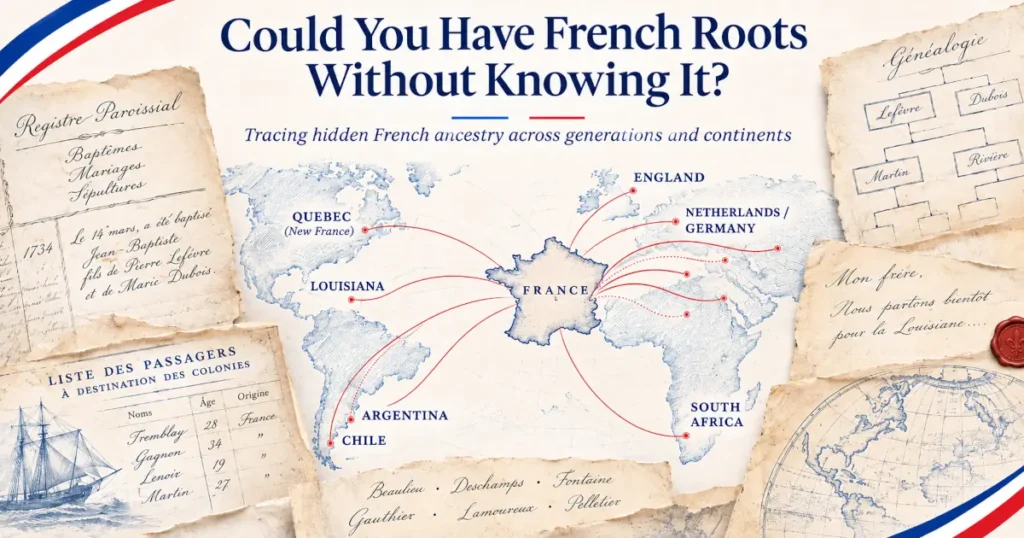
Millions of people around the world have French ancestry, including families whose connection to France goes back several centuries. The history of French migration reveals how these family connections developed across Europe, the Americas and other parts of the world.
A French surname in Argentina, a family with ancestors from Quebec, or a South African whose forebears arrived at the Cape in the seventeenth century: each can be part of the wider history of French migration.
For centuries, people left France to establish homes, businesses and communities abroad. Their descendants became part of the societies in which they settled, often adopting new languages and customs. Over generations, knowledge of the family’s original homeland sometimes disappeared.
Today, French ancestry is found in countries whose populations have been shaped by several waves of European migration. Canada and the United States are familiar examples, but there are also substantial historical connections with Argentina, Chile, England, the Netherlands, Germany and South Africa.
The origins of these connections are worth exploring, particularly for families who have never considered the possibility of French ancestry.
French Ancestry in Canada and the United States
The French presence in North America began with the establishment of permanent settlements during the early seventeenth century.
Samuel de Champlain founded Quebec in 1608, and the colony of New France gradually developed along the St. Lawrence River. French settlements also appeared in Acadia, around the Great Lakes and in the Mississippi Valley.
The settlers came from across France, although the Atlantic regions supplied a particularly large proportion. Normandy, Poitou, Aunis, Saintonge and the Paris region were important places of origin. Ports such as La Rochelle, Rouen, Dieppe and Saint-Malo served as departure points for people travelling to the colonies.
According to the Canadian Museum of History, approximately 10,000 immigrants formed the founding population of French colonial Canada. The figure refers to settlers who remained and established families, rather than everyone who crossed the Atlantic during the French colonial period.
Among these settlers were the Filles du Roi, or King’s Daughters. Between 1663 and 1673, more than 800 young women travelled to New France through a programme supported by Louis XIV to encourage marriage and population growth.
Many became the ancestors of large French Canadian families. Their descendants now number in the millions, extending far beyond the province of Quebec.
During the nineteenth century, French Canadians migrated in considerable numbers to the northeastern United States. Industrial towns in Massachusetts, Maine, New Hampshire, Rhode Island and Vermont attracted workers from Quebec, particularly to their textile mills.
These migrants established French-speaking neighbourhoods, churches, schools and newspapers. Cities such as Lowell, Manchester and Woonsocket developed substantial French Canadian communities.
The Library of Congress records the importance of French-language newspapers in these communities, which maintained strong cultural ties with Quebec even as later generations became increasingly integrated into American society.
Louisiana has a different but equally significant French history.
French colonial settlement in the Mississippi Valley, together with the arrival of Acadians and other French-speaking populations, contributed to the development of the region’s distinctive culture.
The Acadians originally settled in what is now Atlantic Canada. Following their dispersal during the eighteenth century, many eventually made their homes in Louisiana, where their descendants contributed to Cajun communities.
French influences remain visible in Louisiana’s place names, family names, cuisine, music and traditions.
For families with roots in Quebec, New England, Acadia or Louisiana, a French connection may reach back to the earliest periods of European settlement in North America.
French Protestant Families Across Europe and South Africa
Another important period of French migration followed the religious conflicts of the sixteenth and seventeenth centuries.
French Protestants, commonly known as Huguenots, established communities abroad after periods of persecution in France. Emigration increased considerably following Louis XIV’s revocation of the Edict of Nantes in 1685.
The British National Archives estimates that approximately 200,000 Huguenots left France, with around 50,000 settling in England.
London became an important centre of Huguenot life. French Protestant merchants, craftsmen and textile workers settled in districts including Spitalfields, where they contributed to the development of the silk-weaving industry.
Huguenot communities also developed in Canterbury, Sandwich and other English towns.
Their influence extended into commerce, banking, printing and manufacturing. Many families became established members of British society, retaining surnames of French origin long after English had become their everyday language.
Elsewhere in Europe, French Protestant refugees settled in the Dutch Republic, Switzerland, Ireland and various German states.
In Brandenburg-Prussia, the arrival of Huguenot refugees was encouraged by the Edict of Potsdam, issued in 1685 by Elector Frederick William. French Protestant settlers contributed to the economic and cultural development of Berlin and other towns.
French ancestry originating in this period is therefore found in families whose history has been associated with Germany or the Netherlands for more than three centuries.
The Huguenot migration also reached South Africa.
In 1688, groups of French Protestant refugees arrived at the Cape of Good Hope under the administration of the Dutch East India Company.
They settled in the Cape’s agricultural districts, including Drakenstein and the area later known as Franschhoek, meaning “French Corner.”
Many worked in farming and viticulture. Their descendants became part of South Africa’s Dutch-speaking population, and the French heritage of the Cape remains visible in local history, place names and family names.
One documented example is the surname Viljoen, derived from the French name Villion. François Villion, a Huguenot refugee, arrived at the Cape in 1671.
The change from Villion to Viljoen illustrates how French family names could develop new forms as their descendants became established in a different linguistic environment.
French Migration to Argentina and Chile
South America received substantial European immigration during the nineteenth and early twentieth centuries. Although Spanish and Italian migration is more widely recognized, French immigrants also established communities across the continent.
Argentina was a particularly important destination.
Research published by the French Ministry for Europe and Foreign Affairs estimates that approximately 220,000 French migrants arrived in Argentina between 1810 and 1910, with the largest flows occurring during the later decades of the nineteenth century.
A considerable number came from southwestern France, especially the French Basque Country and Béarn. Migrants also arrived from other regions, including Aveyron and Savoy.
Agriculture and livestock farming attracted settlers to rural districts, while Buenos Aires offered opportunities in commerce, engineering, construction and professional services.
French immigrants established businesses, schools and cultural associations. Their presence became part of the European influence on Argentine urban life during a period of rapid economic development.
French families also settled in neighbouring Uruguay, particularly in Montevideo and surrounding agricultural areas.
Chile provides another example of a longstanding French connection.
French merchants began establishing themselves in Chile during the colonial period, and their commercial activities expanded after the country’s independence.
Valparaíso became an important centre of international trade during the nineteenth century. French merchants operated shops and commercial businesses alongside immigrants from Britain, Germany, Italy and other European countries.
The National Library of Chile identifies several Chilean family names associated with early French settlement, including Letelier, Morandé, Labbé, Droguet and Subercaseaux.
French influence was also evident in education, architecture and the professions. Paris became an important reference point for Chilean artists, intellectuals and members of the country’s growing urban elite.
Families whose ancestors settled in Argentina, Chile or Uruguay during this period have now lived in South America for several generations. French origins may remain familiar in family traditions, or survive chiefly in historical documents and family names.
French Family Names and Their Changing History
Surnames offer an interesting perspective on the movement of French families across national borders.
Many familiar names have centuries of history in France. Martin, Bernard, Dubois, Laurent, Moreau, Lefebvre, Petit and Girard are among the surnames associated with different regions of the country.
French surnames often developed from occupations, geographical features, personal characteristics or the given names of ancestors.
Lefebvre, for example, originated from an old French word for a blacksmith. Dubois refers to someone associated with woodland, while names beginning with Du, De or Des frequently developed from geographical descriptions.
Regional languages have also influenced French family names.
France has historically been home to several linguistic traditions, including Breton, Basque, Occitan, Alsatian and regional forms of French. Family names originating in these communities reflect that diversity.
When families emigrated, their surnames occasionally changed to suit local pronunciation or spelling conventions.
Other French names retained their original form for generations, particularly in communities where French continued to be spoken.
Family ancestry also extends beyond the surname inherited from one’s father. French connections frequently occur through maternal branches, including grandmothers and great-grandmothers whose family names are no longer represented in the present generation.
The history of a family name can therefore offer an interesting starting point for understanding a family’s wider background.
A surname may preserve the name of a place, occupation or ancestor from centuries ago. In other families, the French connection is found in an entirely different branch of the family tree.
French Heritage Across Generations
The history of French migration is also a history of families becoming established in new countries.
The descendants of a seventeenth-century settler in Quebec may now live in California or New York. A Huguenot family that settled in London may have relatives throughout Britain, Australia or North America. French families who emigrated to Argentina in the nineteenth century have descendants living throughout South America and beyond.
Over generations, these family histories have become part of the national histories of their adopted countries.
Migration also changed the way families understood their own identities. French-speaking households gradually adopted English, Spanish, Portuguese, Dutch or German, while marriages connected families with other local communities.
In many cases, the original connection to France can still be identified through historical records.
France has a long tradition of preserving parish registers, civil records and other historical documentation. Combined with records from countries where French emigrants settled, these materials provide important evidence of family relationships and geographical origins.
For those interested in their ancestry, establishing a French connection can add an entirely new dimension to their understanding of family history.
It may identify a particular town or region in France, establish relationships between generations, or explain the origins of a family name that has been used abroad for centuries.
Discovering Your French Roots
French migration has left a substantial family heritage across the world. From the early settlements of Canada to the Huguenot communities of Europe and South Africa, and from French merchants in Chile to agricultural families in Argentina, these connections remain part of the history of millions of descendants.
A professional investigation into family origins can establish where a family’s French ancestors came from, document their relationships across generations and provide a clearer understanding of their history.
Immigration & Citizenship provides professional French genealogical and historical research services for individuals and families worldwide. Our work includes investigating French ancestry, tracing family connections across national borders and locating historical documentation relating to French origins.
If you believe you may have French roots, contact our team to discuss professional research into your family’s history.